

• account

  • log-out

  • log-in

  • cart

  • info
0 Items in your CART
  • ► Stock Signs
      • Road Signs

      • ADA Handicap Parking Signs
      • Parking Signs
      • D.O.T. Traffic Control
      • Road Construction Signs
      • School / Child Safety
      • Auto Safety Signs
      • Directional Signs
      • Yellow Warning Signs
      • Pavement Stencils
      • Safety Signs

      • Hygiene/Covid
      • 911 Address Signs
      • Auto Safety Signs
      • Fire Safety
      • OSHA Signs
      • School Child Safety
      • Reflective Delineators
      • Lighted Exit Signs
      • Wet Floor Safety
      • Safety Vests
      • Signs by Industry

      • Valet
      • Business
      • Construction
      • Parking
      • Schools
      • Real Estate
      • Restaurants
      • Covid/Medical
      • Feather Flags

      • Stock Feather Flags
      • Feather Flag Hardware
      • Lighted Signs

      • Real Neon Signs
      • LED Signs
      • LED Snap Frames
      • Other Signs

      • Architectural Signs
      • ADA Handicap Compliance
      • No Trespassing Signs
      • Miscellaneous Signs

      Stock Signs

  • ► Custom Signs
      • Sidewalk Signs


      • Wall & Fence Signs

      • Yard Signs


      • Decals

      • Thick Metal Signs


      • Lighted Signs

      • Thin Plastic Signs


      • Residential Signs

      • Combo Kits


      • Odd Size & Shape

      • 100-Packs


      • Fabric Prints

  • ► Sign Holders and Systems
      • Banner Holders

      • Indoor Sign Stands
      • Hanging Snap Rail
      • Retractable

      • Sideline Sports Banners

      • APS Advaced Player Safety Banner
      • Sign Holders

      • Indoor Floor Sign Stands
      • Indoor Wall Sign Frames

      • Outdoor Sidewalk Sign Stands
      • Outdoor Yard Sign Stakes and Frames
      • Outdoor Sign Posts
      • Outdoor Wall Brackets
      • Outdoor Real Estate Sign Stakes
      • Table Top Holder

      • Table Top Sign Holder

      • Temporary Sign Holders

      • Disposable Sign Stands

      • Sign Systems

      • Felt Tab Letterboards

      Sign Holders and Systems

  • ► Posts and Hardware
      • Sign Posts

      • U-Channel Posts
      • Pipe Posts
      • Square Metal Posts
      • Portable Sign Posts
      • Impact Recovery Post
      • White Vinyl Posts
      • Temporary Sign Stakes
      • Ornamental Sign Posts
      • Post Hardware

      • U-Channel Post Hardware
      • Pipe Post Hardware
      • Square Metal Post Hardware
      • Square Wood Post Hardware
      • Telephone Pole Hardware
      • Chain Link Fence Hardware
      • Brackets

      • Scroll Brackets
      • Street Sign Brackets
      • Banner Brackets
      • Other Brackets
      • Fasteners

      • Theft Resistant
      • Banding
      • Other Fasteners

      U-Channel Sign Posts

  • ► Tools and Materials
      • Tools

      • Post Installation
      • Vinyl Decal Install
      • Grommet Machines
      • Cutting Mats
      • Rulers and Straight Edges
      • Substrate Cutters
      • Markers
      • Software

      Fletcher Cutters

      • Materials

      • Rigid Sign Blanks
      • Rolled Goods
      • Banner Finishing
      • Outdoor Sign Letters

      Substrates

    Signs Direct's Blog > TRAFFIC and PARKING > 

The History of the Yield Sign

The yield sign is one of the most common signs on the road today, used everywhere from quiet suburban boulevards to busy multi-lane highways. Classified by the United States Department of Transportation (U.S. DOT) as an “R1-2 Regulatory Sign,” it is considered to be one of the most important road signs, ranking just below the stop sign in terms of its usefulness in maintaining order on our public streets and thoroughfares.

Tulsa, Oklahoma – Birthplace of the Yield Sign
Like most inventions, the yield sign was developed to solve a widespread, and growing, problem – traffic accidents caused by drivers failing to yield the right-of-way. In 1950, Clinton Riggs, a Highway Trooper in Tulsa, Oklahoma, concluded that a sign was needed at the corner of Columbia Avenue and First Street to remind drivers about the law requiring them to slow down and respect the right-of-way of other drivers. Officer Riggs believed that such a sign would help to both reduce crashes and clarify which driver was at fault; within one year of the installation of his “Yield” sign, vehicle crashes at the test intersection dropped dramatically, leading to the widespread installation of yield signs on roadways throughout the country.

The Four-Sided Yield Sign
According to traffic sign enthusiast Stephen Salcedo, owner of the website “My Crazy Hobby,” one of the rarest types of yield sign was the the four-sided yield sign, shaped like an upside-down trapezoid. Used in low-traffic areas (like residential neighborhoods) in California throughout the 1950’s as an alternative to the stop sign, these signs were yellow with either painted or embossed black writing. The text on these unique signs read “Yield Right of Way” rather than just the standard “Yield”; by the 1960s, these four-sided signs were replaced with the standard inverted triangular yield signs.

The Yellow Years
According to the website TrafficSign.us, yield signs throughout the United States were solid yellow with a narrow black border and the word “Yield” written in solid black letters for almost two decades [http://www.trafficsign.us/yellowyield.html]. The yellow yield sign was introduced in 1954 in the U.S. DOT’s MUTCD (Manual on Uniform Traffic Control Devices)

The Yield Sign Today
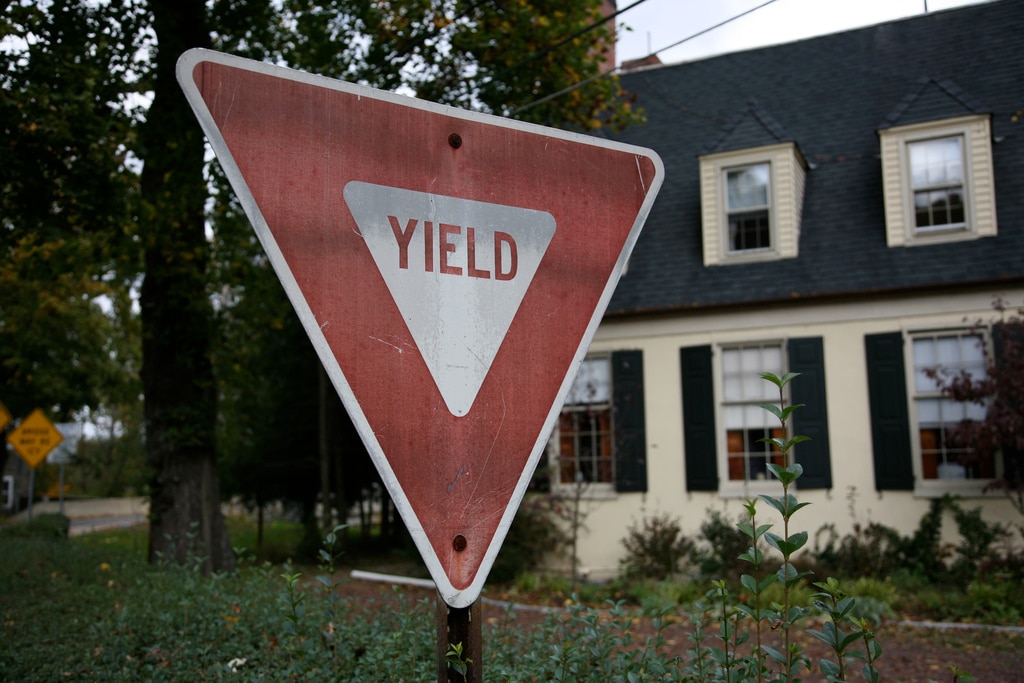
In accordance with U.S. Department of Transportation regulations, yield signs on public roads throughout the country were standardized in 1971 to help minimize confusion for drivers traveling through different states. The modern American yield sign is an inverted, symmetrical triangle; the outer edge of the sign is bordered with a thick, solid red line while the word “yield” is printed onto the inside white triangle in red, capitalized letters.

Variations On The Yield Sign
While the yield sign is most often displayed on its own, in some circumstances, the red and white “yield” triangle is added onto another sign to convey a more detailed message about what, or who, drivers are expected to yield to. One common example of a blended yield sign is found in states where drivers must yield to pedestrians; in these states, rectangular white regulatory signs with both a printed yield sign and an image of a pedestrian are often posted at crosswalks to remind drivers they must yield to pedestrians.

Regardless of where a yield sign is displayed or what color (or shape) it is, throughout the world, the meaning remains the same; drivers must be prepared either to slow down or to stop in order to “give way” to pedestrians, cyclists and other vehicles who have the right-of-way.



Author : Tom Dalton

Date Posted : 2/1/2013


  • Contact Us
  • |
  • Privacy Policy
  • |
  • Upload Tool
  • |
  • ★ Reviews ★
  • |
  • Sitemap
  • |
  • Blog
  • |
  • Industry Links
  • |
  • Gift Certificates
  • |
  • Terms & Conditions
  • Shopping Cart

© Signs Direct Inc. All Rights Reserved. All trademarks, graphics or photos not owned by Signs Direct Inc are the property of their respective owners.
Pictures may not be an exact representation of products. Signs Direct only ships to the USA and Canada at this time. Prices are subject to change without notice.